
From Econ River High School to the Frontiers of Space
A flexible approach to education helped Noah balance family responsibilities, complete high school, and build a career in aerospace engineering.
Noah has dedicated his life and career to serving his family and his country. At age 12 he started mowing lawns to contribute to the family expenses, and at sixteen he began working two jobs. The youngest of seven children with a single mom, Noah felt a strong sense of responsibility to help support his family. At school, Noah loved and excelled in the sciences. A good student, he connected easily with the STEM curriculum, and was particularly drawn to the study of space. However, come senior year Noah found the daily eight-hour structure of conventional high school no longer aligned with his financial needs, and he remembers leaving classes early to take on more hours at work.
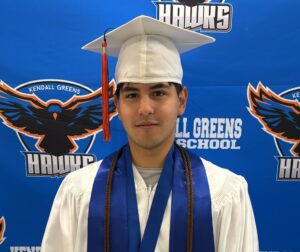
A proactive kid, once Noah identified a problem, he immediately sought to find a solution. “If the traditional classroom is not working for you, the best option is you find a new place to succeed.” He made the decision to transfer at the beginning of his second semester Senior year, and Econ River ended up being an ideal academic alternative. “An incubator for success,” Noah appreciated the flexibility that the school offered. While he primarily enrolled in the morning session, the school was accommodating if he needed to attend some classes in the afternoon.
In the classroom Noah “loved being able to go to either economics or statistics or to US history, or whatever [I was] feeling on that day, and just work on it…You get to control your own learning environment…The curriculum was flawlessly put together for you so that you could efficiently move on.” He remembers the teachers being knowledgeable across multiple subject areas and willing to reach out to others within the school if more help was needed. “Everyone was so much nicer and more motivated personally with the students. There’s a lot more one of one interaction than in a giant high school.”
Shortly after completing his last class, Noah enlisted with the Air Force and departed for boot camp. “I had my eye on what was next.” Beyond his patriotism and desire to serve his country, Noah “wanted to travel, gain skills…learn everything. I wanted to know everything, and I wanted to get out of the situation I was in.” He felt the military offered a more global perspective of how the world operates. During his four years with the Air Force, Noah earned his associate degree in Intelligence Studies as well as a Software Engineering Certificate from Air University. He’s now a few credits shy of completing his undergraduate degree in Space Studies with American Military University and about year away from earning his Civil Engineering Degree. Stationed in Colorado, Noah specialized in Intelligence working with the Air Force Space Command, ensuring that missions were executed without interference and protecting access to and from space, gathering resources, and helping establish bases. He was also part of the second group of transfers into the newly implemented Space Force. “The thing I love about space is that you’re constantly finding something new that’s making you rethink what you thought before.”
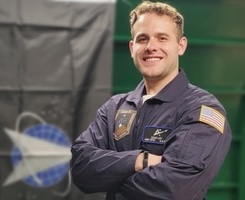
After leaving Space Force, Noah went to work as a System Engineer at Sierra Space where he was responsible for understanding how all the subsystems within a space craft integrate and work together from a military integration standpoint. He was also accountable for ground operations, ensuring Sierra Space is getting the right ground support equipment and assets from the Space Force and the Department of Defense, and integrating these assets with the company’s own capabilities prior to a launch or landing. He currently works as an Aerospace Systems Engineer at Blue Origin. Addressing the misconceptions people may have about qualifications to work in this kind of advanced environment, and the feeling that you must be a rocket scientist to work in his field, he notes that there’s “so much more than just rocket science to understanding space. Especially now.”
Reflecting on his years in high school, Noah recognizes that the traditional high school set up “can hinder some really bright people…especially if you don’t come from a traditional family…or you don’t think in a traditional sense.” For those seeking a different type of learning environment or considering making a switch, Noah says that “every new and unknown option is scary, especially when you’re in high school, but…you don’t want to be the person that only takes the safe options for too long because then you get no opportunity to grow, to get your feet wet, to figure out what it is in life you really enjoy doing.”